


 Download Product Ebook
 View all our solutions
 Sky-Walker Architecture
 View all our integrations
 Book Protocol workshop
 Our Company
 Contact Us
 View All Our Case Studies
 Become a PSIM Partner
 Become a Sky-Walker PSIM partner today!
 English
 Français
 Nederlands
Smart City Integration Platform for Connected Urban Environments
Transform your city into an intelligent, connected ecosystem. Sky-Walker's smart city platform unifies security, safety, and comfort systems across your entire urban environment, enabling real-time monitoring, automated responses, and data-driven decision-making for improved resident safety, operational efficiency, and quality of life.
The Future of Smart Cities
Smart cities leverage interconnected systems, IoT sensors, and intelligent software to optimize operations, enhance safety, and improve resident quality of life. Sky-Walker is the integration backbone that makes this vision a reality.
What Defines a Smart City?
A smart city is a comprehensively connected urban environment where diverse systems—security infrastructure, safety networks, building controls, transportation systems, and citizen services—operate as an integrated whole. Through information technology and the Internet of Things (IoT), smart cities collect, process, and act on data to optimize operations, enhance safety, and improve resident experiences.
Smart city by using security drones for fire detection and evacuation
Key Characteristics of Smart Cities
Interconnected Systems
Security, safety, comfort, and operational systems communicate seamlessly.
Real-Time Data Collection
Sensors throughout the city continuously
gather data on conditions,
events, and activities.
Centralized Monitoring
Unified dashboard provides comprehensive visibility across all city systems.
Intelligent Automation
Systems respond autonomously to detected conditions within programmed parameters.
Data-Driven Decisions
Operators use real-time analytics to make informed, rapid decisions.
Resident Engagement
Citizens access city information and services through mobile apps and digital platforms.
Smart City System Categories
Sky-Walker integrates three primary system categories into a unified smart city platform:
Safety Systems
- Fire Detection & Suppression: Detect fires instantly and trigger coordinated response protocols.
- Fire Protection Systems: Automatic sprinkler activation, emergency shut-off valves, and suppression controls.
- Public Address Systems: Facility-wide emergency announcements and resident notifications.
- Perimeter Security: Perimeter intrusion detection for critical infrastructure protection.
- Emergency Dispatch: Integrated emergency response coordination and resource allocation.
Security Systems
- CCTV & Video Surveillance: City-wide video monitoring with integrated analytics.
- Access Control: Manage entry to critical facilities and secure zones.
- Intercom & Communication: Two-way communication between operators and residents/staff.
- Intrusion & Burglary Detection: Alert operators to unauthorized access attempts.
- Automated Gates & Barriers: Control vehicle and pedestrian traffic to restricted areas.
Comfort Systems
- HVAC & Climate Control: Maintain comfortable temperatures in public spaces and facilities.
- Intelligent Lighting: Optimize illumination levels based on time of day, occupancy, and conditions.
- Escalators & Elevators: Monitor and maintain safe operation of transportation systems.
- Occupancy & Congestion Monitoring: Track crowd density and movement patterns in public spaces.
- Air Quality Monitoring: Continuous environmental quality assessment
From Traditional to Smart: The Transformation Process
Smart city transformation isn't about replacing everything; it's about connecting what you have. The path to a smart city involves systematically integrating existing and new systems into a unified platform.
Assess Current Infrastructure
Document all security, safety, comfort systems currently deployed across your city.
Design Integration Architecture
Plan how systems will connect, communicate, and share data through Sky-Walker platform.
Deploy Sky-Walker Platform
Implement the central
integration and management platform with appropriate redundancy and security.
Connect Systems Incrementally
Integrate systems in phases
starting with critical systems,
then building outward.
Enable Real-Time Monitoring
Display all connected systems in unified dashboards providing city-wide visibility.
Automation Workflows
Create intelligent workflows where systems communicate and trigger coordinated responses.
Optimize & Expand
Continuously optimize operations and add new systems and capabilities as the platform matures.
Smart City Applications & Use Cases
Energy efficiency
Through efficient systems and applications, cities are able to significantly improve their energy balance and contribute to environmental protection.
Public safety
Governments can monitor areas of high crime to improve emergency preparedness, address citizens when in a natural disaster and increase well-being.
Public transportation
To ensure comfort, travelers can get real time modifications about their route. accessibility of driving capabilities, road conditions and vehicle performance making use of sensors.
Sustainability
To create an enduring way of life across the four domains of ecology, economics, politics and culture. By monitoring safety, cleanliness, crowd density, temperature etc.
Traffic management
Ensure better traffic flow through real -time information exchange between road users and traffic. This enables the city to anticipate traffic situations, which in return improves traffic flows and safety.
Public monitoring
Because citizens can have access to the internet everywhere in the city, a city app for example, can be used by citizens to help in the monitoring of their own city. Operators can then handle these alarms.
Sky-Walker is a smart choice for smart cities
A smart city software integrates a combination of a PSIM and a BMS. The operators can connect all safety, security and comfort systems to have an overview of the buildings present in the city and the resident's activities being performed. It is also possible to use technology to track cars, buss and street lights to collect data.
The smart city management software Sky-Walker will then help you to integrate all the technologies required to be present in the smart city. It will also allow for the monitoring of the incidents occurring and the potential preventive measures to take. Moreover, thanks to our reporting module, all the data retrieved from the actions taken within the environment can be easily viewed.
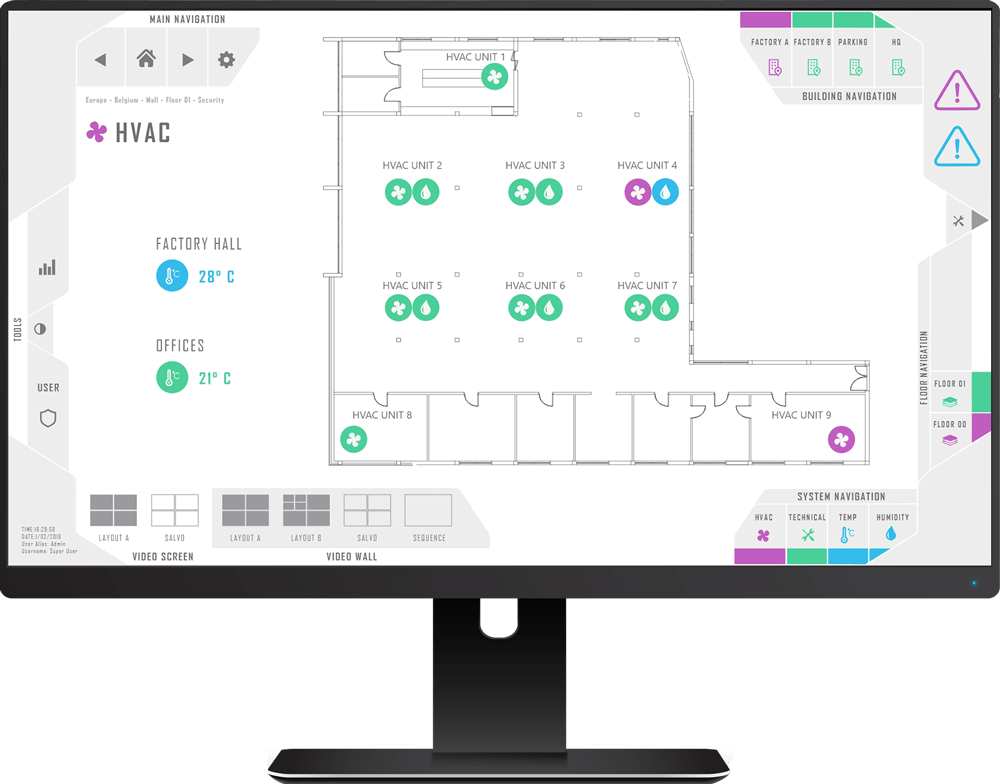
Sky-Walker software
The smart city solutions
Reduce energy consumption
Better safety and security in everyday life
Better comfort on the road
Contribution to sustainable development
Traffic flow
Real-time data visibility for inhabitants
Frequently Asked Questions
What is the difference between a smart city and a traditional city?
A traditional city operates systems independently—CCTV is separate from access control, which is separate from traffic signals. A smart city integrates all systems into one platform, enabling coordination, data sharing, and automated responses.
How long does smart city transformation take?
Timeline varies based on city size and existing infrastructure. Pilot projects take 3-6 months. City-wide rollouts typically take 12-24 months with phased implementation.
Do I need to replace my existing systems?
No. Sky-Walker integrates with existing systems. You can gradually add new systems or upgrade existing ones as budgets allow, while maintaining operation of your current infrastructure.
What about cybersecurity in a smart city?
Smart city systems are attractive to cybercriminals. Sky-Walker implements multi-layered security: encrypted communications, access controls, comprehensive audit logging, and intrusion detection. We recommend regular security audits.
How many systems can Sky-Walker manage?
Sky-Walker scales to manage thousands of connected devices across a city. Our R&D team ensures the platform remains responsive even with massive system counts.
hat kind of data does a smart city generate?
Enormous amounts: security events, traffic patterns, energy consumption, environmental conditions, resident services requests, emergency incidents. This data is invaluable for optimization and planning.
Who operates the smart city platform?
Typically a central control room with trained operators. Command center staff monitor dashboards, respond to alerts, and manage emergency coordination.
How do we involve citizens in a smart city?
Mobile apps enable residents to report issues, request services, and receive alerts. This crowdsourced information supplements sensor data and improves city responsiveness.
What ROI can cities expect?
Typical benefits: 20-30% reduction in energy costs, 30-50% improvement in emergency response times, 15-25% reduction in operational staff requirements. Additional benefits include improved safety and resident satisfaction.
Which cities use smart city platforms?
Leading examples include Songdo (South Korea), Barcelona (Spain), Copenhagen (Denmark), Singapore, and Tokyo. Hundreds of cities worldwide are implementing smart city initiatives.